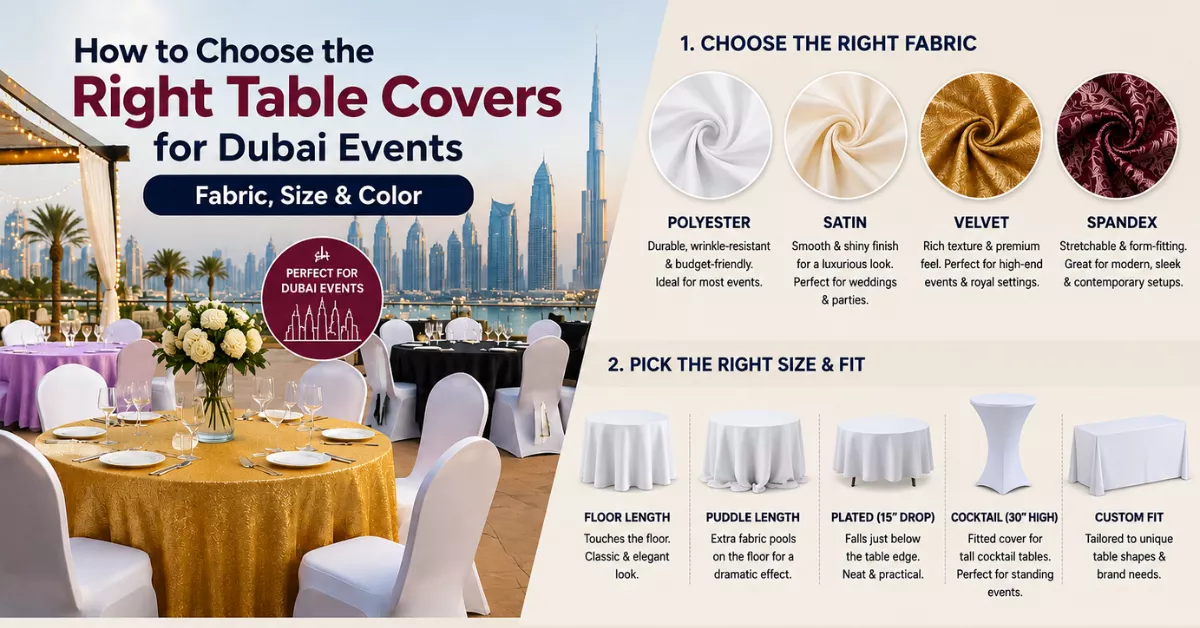
Table covers rarely get top billing on an event mood board, but they do more work than almost any other rental item on the floor plan. A well-fitted, well-chosen cover pulls a room together a wrinkled or ill-fitting one undercuts everything else you’ve spent on décor. Whether you’re dressing a corporate gala at a Downtown Dubai hotel, a wedding reception in the Gardens, or an exhibition booth at DWTC, the fabric, the fit, and the color you pick all carry weight. Here’s a practical guide to getting each of those three decisions right.
Why the Fabric You Choose Matters More Than You Think
Dubai events come with two variables most guides don’t account for: heat and frequency of reuse. Outdoor and marquee setups deal with humidity swings and air-conditioning drafts, while venues doing back-to-back events need linen that survives repeated laundering without losing its finish. Fabric choice should be led by the event environment first, and by look second.
| Fabric | Best For | Things to Know |
|---|---|---|
| Polyester | Corporate events, exhibitions, everyday rentals | Wrinkle-resistant, holds colour well, easy to launder in bulk |
| Spandex/Lycra | Cocktail tables, fitted looks, modern branding | Stretch-fit for a sleek line, shows every seam if the table is uneven |
| Satin | Weddings, galas, formal dinners | Reflective sheen under lighting, creases easily, needs steaming before use |
| Taffeta | Statement head tables, stage skirting | Crisp structure and rustle, less suited to long buffet runs |
| Cotton/Poly-cotton blend | Daytime functions, casual and outdoor setups | Breathable and matte, softer drape, less resistant to spills |
For Dubai’s climate specifically, polyester and poly-cotton blends tend to be the safer default for anything outdoors or in a partially open venue, since they resist the limp, clingy look that pure cotton can get in humidity. Satin and taffeta are worth reserving for indoor, climate-controlled settings where the fabric can hold its shape.
Getting the Sizing Right
Sizing is where most last-minute event-day issues come from not the fabric or the color. A cover that’s too short exposes table legs and looks unfinished; one that’s too long pools on the floor and becomes a trip hazard. The two numbers that matter are the table dimension itself and the “drop” how far the fabric hangs down each side.
| Table Type | Standard Size | Cover Size for Floor-Length Drop |
|---|---|---|
| Round table (banquet) | 60 in (5 ft) diameter | 120 in round |
| Round table (banquet) | 72 in (6 ft) diameter | 132 in round |
| Rectangular trestle | 6 ft x 2.5 ft | 90 in x 156 in |
| Rectangular trestle | 8 ft x 2.5 ft | 90 in x 180 in |
| Cocktail/highboy table | 30 in diameter, 42 in height | 108–120 in round (fitted spandex preferred) |
A quick rule of thumb: for a full floor-length drop, take the table’s width or diameter and add roughly 60 inches (30 inches per side) to the cover size. For a lap-length drop which sits just below the tabletop edge, exposing the legs you’re generally looking at only 6 to 15 inches of overhang per side, a common choice for exhibition booths and casual daytime events where full-length linen isn’t necessary.
It’s worth measuring the actual tables at the venue rather than relying on catalogue standards, since trestle tables in particular can vary slightly between suppliers.
Choosing Colors That Work for the Occasion
Colour is where table covers do the most visible work, and the right choice depends heavily on what kind of event you’re dressing.
- Corporate events and conferences: neutral tones — white, ivory, charcoal, or a brand color used sparingly on runners rather than the full cloth keep the focus on signage and presentations.
- Weddings and social celebrations: this is where seasonal and cultural palettes come in. Blush, gold, and ivory remain steady choices for Dubai weddings, while richer jewel tones (emerald, burgundy, deep teal) work well for evening receptions.
- Ramadan and Eid gatherings: deep greens, gold accents, and warm neutrals are widely used to reflect the season, often paired with metallic runners.
- Exhibitions and trade shows: solid, brand-matched colors in polyester read cleanest under booth lighting and photograph well for stand visuals.
A practical habit worth building into any planning process: bring or request a fabric swatch before committing to a colour for a large order. Screen and print renderings shift color more than people expect, and satin in particular can look noticeably different under warm venue lighting versus daylight.
A Few Practical Notes Before You Order
- Order 10–15% more covers than your table count to allow for last-minute layout changes or a stained cloth mid-event.
- Ask whether pressing or steaming is included in the rental satin and taffeta almost always need it after transport and storage.
- For long events or multi-day exhibitions, confirm whether same-day replacement is available in case of spills.
- If you’re mixing fabrics across a room (say, spandex on cocktail tables and satin on dining tables), keep the colour family consistent so the mix reads as intentional rather than mismatched.
Why Rent Instead of Buy
For most event organizers and venues, renting table covers makes more practical sense than purchasing and storing them outright especially in a city where event needs shift by season, guest count, and brief.
- No storage burden: Satin, taffeta, and spandex all need proper folding, humidity control, and pressing between uses to avoid creasing or mildew. Renting removes the need for dedicated linen storage, which most venues and planners simply don’t have space for.
- Access to a wider fabric and colour range: A single event might call for satin at the head table, polyester elsewhere, and a brand colour that won’t be needed again for months. Buying enough stock to cover every combination ties up capital in linen that sits unused between events.
- Consistent quality without the maintenance: Commercial-grade laundering, steaming, and stain treatment are handled by the rental supplier, so covers arrive pressed and event-ready rather than needing in-house care after every use.
- Easier scaling for variable guest counts: Corporate events, weddings, and exhibitions rarely have identical numbers each time. Rental lets you order exactly what a specific event needs rather than owning for peak capacity and storing the surplus the rest of the year.
- Lower cost per use for one-off or seasonal needs: Purchasing makes more sense only for a venue running near-identical setups daily; for most planners, the per-event rental cost is lower than the combined cost of buying, cleaning, storing, and eventually replacing worn linen.
- Damage and wear risk shifts to the supplier: Spills, tears, and fabric fatigue from heavy use are the rental company’s responsibility to replace, not an ongoing cost the organizer has to absorb.
Bringing It Together
Table covers are one of the few décor elements that touch every guest interaction point in a room, from the registration desk to the dining table. Getting the fabric right for the venue and season, sizing the drop accurately, and choosing colors that suit the occasion will do more for the finished look of an event than most people expect from something so functional. When in doubt, matching fabric to environment and letting colour follow the occasion is a dependable starting point for any event size. Contact Pink Pepper Catering Services LLC for quality table cover rentals in various fabrics, sizes, colors, and styles to match your event theme.
Quick Answers
1. What size table cover do I need for a standard 6ft trestle table?
For a full floor-length drop, you’ll want roughly 90in x 156in. If you prefer a shorter café-style drop that shows the table legs, a smaller cover with 6-15 inches of overhang per side works fine just confirm the exact table dimensions with your venue first, since trestle sizes can vary slightly between suppliers.
2. Which fabric holds up best for outdoor events in Dubai’s climate?
Polyester and poly-cotton blends are generally the safest choice outdoors. They resist the limp, clingy look that pure cotton and lighter fabrics can develop in humidity, and they’re more forgiving with wind and quick weather changes than satin or taffeta.
3. Can I mix different fabrics or drop lengths at the same event?
Yes — it’s common to use fitted spandex on cocktail tables and a longer satin or polyester drop on dining tables. The key is keeping the color palette consistent across the mix so it reads as a deliberate styling choice rather than mismatched linen.
4. Is it better to rent or buy table covers for a recurring event series?
For most planners and venues, renting still works out more practical even with recurring events, since it avoids the storage, laundering, and upkeep that fabrics like satin and taffeta demand between uses. Buying only tends to make sense if a venue is running near-identical setups on a near-daily basis.
5. How do I make sure the color I choose will look right on the day?
Always request a physical fabric swatch before finalizing a large order — screen renderings and printed catalogues shift color noticeably. This matters most for satin, since its sheen can look quite different under warm venue lighting compared to daylight or a showroom.