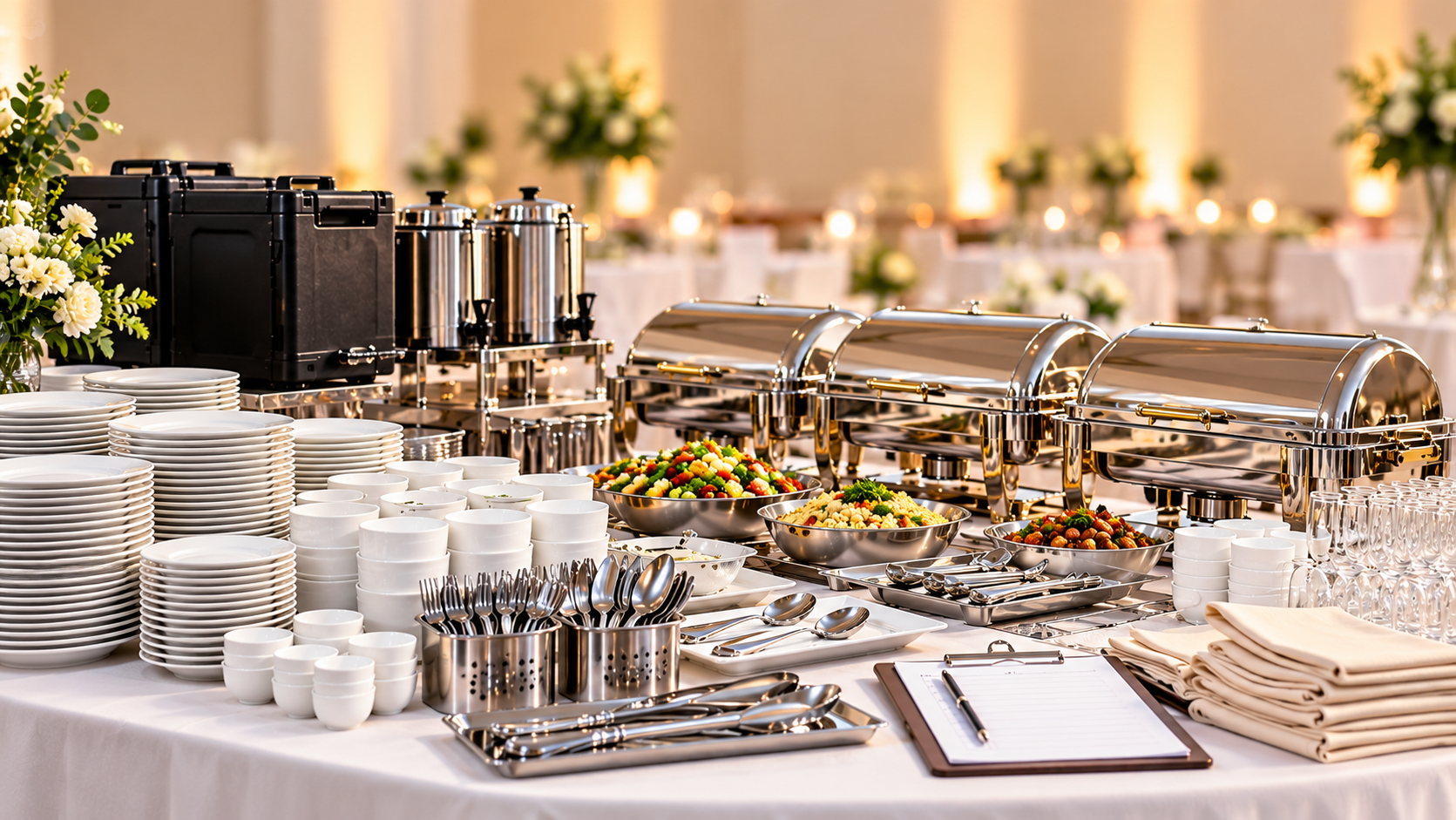
Working out how much catering equipment per guest you need is where most event budgets go wrong. Order short and the service stalls mid-event. Order long and you have paid for crates nobody opened. The gap between the two is not guesswork — it comes down to service style, menu length and a sensible buffer.
This guide gives working catering equipment per guest numbers for crockery, cutlery, glassware, hot service and furniture, and shows how to adjust them. Treat every figure as a planning baseline to check against your own menu, not a fixed rule.
Start With Service Style, Not Headcount
The headcount tells you almost nothing on its own. A hundred guests at a plated three-course dinner and a hundred at a roaming canapé reception need completely different quantities of catering equipment per guest, because the number that actually drives the count is how many times each guest picks up a clean item.
- Plated service — predictable. One setting per course, cleared and replaced by staff.
- Buffet service — higher. Guests return to the line and take a fresh plate each time.
- Canapé or roaming — highest per head on small items, lowest on large. Guests cycle through many small plates and glasses.
- Family style — moderate on tableware, heavy on serving dishes at the table.
Fix the service style first. Everything below adjusts from it.
Crockery: The Core Catering Equipment Per Guest Count
For a plated dinner, work from one dinner plate, one starter or quarter plate, one soup bowl and one dessert plate per guest — a clean item per course, no more.
For a buffet, raise it. Guests make a second and often a third trip, and few will reuse a plate. A practical baseline is 1.5 to 2 dinner plates per guest, plus one quarter plate, one bowl and one dessert plate. For a long iftar or wedding buffet with many menu lines, use the upper end.
For canapé receptions, small plates run at roughly two to three per guest across the event, with very few dinner plates needed at all.
Our crockery rental range is sized for banquet volumes, so these quantities can be built in full sets rather than assembled piecemeal.
Cutlery Per Guest
Cutlery is the easiest part of the catering equipment per guest count to under-order, because the count is driven by courses rather than guests. One full place setting per course means a four-course plated dinner needs four pieces or pairs per guest before you have touched the serving cutlery.
Work from this:
- Plated dinner — one knife, fork and spoon per course served
- Buffet — a full setting per guest, plus 20% spare, since settings go back to the wash with half-finished plates
- Dessert and coffee — dessert spoons or forks per guest, plus teaspoons at 1.5 per guest, the single most commonly short item at any event
- Serving cutlery — one dedicated spoon, ladle, tong or slice per dish on the line, never shared
See the cutlery rental range for full banquet settings and serving pieces.
Glassware Per Guest
Glassware turns over faster than anything else, because guests set a glass down, walk away and take a fresh one without thinking about it.
Plan 2.5 to 3 glasses per guest across a standard dinner event — water, juice and a hot-beverage cup. For a reception with a drinks service running several hours, 3 to 4 per guest is more realistic. Where the event has a dedicated bar, add glassware for the bar separately rather than counting it inside the dining figure; the bar counter and barware range covers that side.
Of all the catering equipment per guest calculations, this is the one worth rounding up. Running out of clean glasses mid-event is far more visible to guests than running out of anything else. Our glassware rental range covers water, juice and hot-beverage service.
Hot Service: Chafing Dishes and Holding Equipment
Hot service breaks the pattern: unlike the rest of your catering equipment per guest planning, it is counted by menu item rather than by guest. The working figure is one chafing dish per hot menu item per 80 to 100 guests. Past roughly 150 guests, duplicate the full set on a second mirrored buffet line rather than adding more food to one line — the queue, not the food, is the bottleneck.
Adjust upward for items everyone takes, such as rice and biryani, and downward for sides. Our chafing dish rental range covers rectangular, round and soup formats.
Behind the line, allow holding capacity for roughly one full refill of every hot item. Hot holding cabinets and bain-marie units from our commercial kitchen equipment rental keep backup pans at temperature so staff are not returning to the kitchen for every refill.
Serving Equipment and Buffet Accessories
These sit outside the catering equipment per guest maths and are counted per dish and per station instead:
- One serving utensil per dish, plus spares
- Platters and bowls for every cold item, in mixed sizes
- Elevation risers so a long line reads clearly from a distance
- One beverage station per 100 guests, sited away from the food line
- Ice buckets, tongs and scoops at the beverage and dessert ends
- A buffet tag for every single dish
Our buffet accessories and serving equipment range covers these.
Tables, Chairs and Linen
Furniture is the one area where the catering equipment per guest figure is firm. Round tables seat eight to ten; allow 60 to 70 cm of table edge per seated guest. For the buffet itself, allow roughly one 6-foot trestle per two to three hot dishes once chafers, risers and serving space are accounted for.
Linen follows the furniture count, not the guest count — one cover per table plus skirting for every buffet trestle. For any multi-day or nightly event, take a second linen set so one can launder while the other is in service. See the tables and chairs rental range and the table covers and linen range.
Always Add a Buffer to Your Catering Equipment Per Guest Count
Every catering equipment per guest quantity above is a service figure. On top of it, add a working buffer of 5 to 10% for breakage, items that go back to the wash mid-service and the plate that ends up somewhere it should not.
Clean, correctly handled tableware also sits under Dubai Municipality Food Safety Department requirements, so the buffer is not only about breakage — it is what lets you pull an item out of service without stalling the line.
Worked Example: 150-Guest Buffet Dinner
Putting the catering equipment per guest figures together for a single-line buffet dinner with six hot dishes:
- Dinner plates — 150 × 1.75 = 263, round to 270
- Quarter plates — 150, plus buffer = 165
- Soup bowls and dessert plates — 165 each
- Place settings — 150 full settings plus 20% = 180
- Teaspoons — 225
- Glassware — 150 × 3 = 450
- Chafing dishes — 6 dishes × 2 (150 guests) = 12, run as two mirrored lines
- Serving utensils — 6 plus spares
- Guest tables — 15 rounds of ten, plus 5 buffet trestles
- Linen — 15 covers plus skirting for 5 trestles
Those are the numbers to check your quote against before anything is confirmed.
Get Your Catering Equipment Per Guest Count Checked
The fastest way to get catering equipment per guest right is to work backwards from your actual menu rather than a generic list. Send us your guest number, service style and menu structure and we will build the equipment counts with you, across tableware, hot service, furniture and linen.
Request an equipment quote and we will come back with quantities and availability for your date.
Frequently Asked Questions
How much catering equipment per guest do I need for a buffet?
More than for a plated dinner, because guests return to the line with a fresh plate each time. Work from 1.5 to 2 dinner plates per guest, one quarter plate, one bowl and one dessert plate, a full cutlery setting plus 20%, and 2.5 to 3 glasses. Add a 5 to 10% buffer on top of all of it.
How many plates should I allow per guest?
One per course for plated service. For buffets, raise the catering equipment per guest figure to 1.5 to 2 dinner plates, because few guests reuse a plate on a second trip. Long buffets with many menu lines sit at the upper end of that range.
How many glasses per guest should I order?
Between 2.5 and 3 per guest for a standard dinner event, rising to 3 or 4 for a reception running several hours. Glassware turns over faster than any other item because guests set a glass down and take a fresh one, so this is the figure worth rounding up.
How many chafing dishes do I need?
One per hot menu item per 80 to 100 guests. Above roughly 150 guests, duplicate the whole set on a second mirrored line instead of adding food to one line, since the queue rather than the food volume is the constraint.
Why do I keep running short of teaspoons?
Because they are counted per guest when they are actually used more than once — with dessert, with coffee and with tea. Allow 1.5 teaspoons per guest rather than one, and it stops being a problem.
What buffer should I add to my equipment order?
Between 5 and 10% above your catering equipment per guest service count, for breakage and for items that go back to the wash mid-service. For multi-day or nightly events, go to the upper end, since handling and washing compound across days.
Does service style really change the quantities that much?
Yes, and it is the biggest single variable. The same 100 guests need materially different catering equipment per guest at a plated dinner, a buffet and a canapé reception, because the count is driven by how many clean items each guest picks up, not by how many guests are in the room.
Can you work out the quantities from my menu?
Yes. Send your guest number, service style and menu structure and we will build the counts across crockery, cutlery, glassware, hot service, furniture and linen, including the buffer. Contact us to start.